
Fintechzoom.com etf market research can help readers understand exchange-traded funds with more confidence This guide groups the related ideas investors usually search for around ETFs, market tracking, fund analysis, and portfolio planning Use it as an educational guide, not personal financial advice.
Quick Bio
| Feature | Details |
|---|---|
| Core Definition | The Fintechzoom.com etf market topic refers to ETF-related news, market explainers, fund comparisons, and investment education connected with FintechZoom-style financial coverage. |
| Origin | ETFs became widely known in the U.S. after the SPDR S&P 500 ETF Trust was created in January 1993, helping investors trade a diversified fund like a stock. |
| Primary Use | Investors use ETF market research to study diversification, fees, liquidity, index tracking, sector exposure, and market trends. |
| Industry | Financial technology, investment research, asset management, online brokerage, market news, and investor education. |
| Common Materials | ETF prospectuses, benchmark indexes, price charts, holdings data, expense ratios, trading volume, bid-ask spreads, and regulatory filings. |
| Popular Applications | Long-term investing, sector rotation, passive index exposure, thematic investing, income strategies, crypto ETF tracking, and portfolio diversification. |
| Risk Level | Varies by ETF type. Broad-market ETFs may carry market risk, while leveraged, inverse, commodity, and crypto ETFs can carry higher risk. |
| Best Research Habit | Compare FintechZoom-style insights with official ETF issuer pages, SEC resources, FINRA education, and fund documents before making decisions. |
Fintechzoom.com etf market Overview
The Fintechzoom.com etf market topic sits at the meeting point of ETF education, market news, and financial technology. Readers often search it because they want simple explanations of exchange-traded funds, current market signals, and practical ways to compare funds.
An ETF, or exchange-traded fund, is a pooled investment product that trades on an exchange like a stock. It may hold stocks, bonds, commodities, crypto-linked assets, or a mix of securities, depending on its structure. FINRA notes that most ETPs are ETFs registered and regulated as investment companies, while some commodity or currency products may follow different rules.
FintechZoom describes ETFs as baskets of securities that trade on stock exchanges and often track indexes such as the S&P 500. That simple framing is helpful for beginners, but smart research should still include fund costs, holdings, liquidity, and risk checks.
Related Keyword Groups Around the Main Topic
| Keyword Group | Related Terms to Use Naturally |
| ETF Basics | exchange-traded fund, ETF meaning, ETF investing, ETF structure, index fund |
| Market Research | ETF market analysis, ETF trends, fund flows, market data, price movement |
| Cost Terms | expense ratio, management fee, trading cost, bid-ask spread, tracking error |
| Portfolio Terms | diversification, asset allocation, risk management, income funds, growth funds |
| ETF Types | stock ETF, bond ETF, sector ETF, thematic ETF, commodity ETF, crypto ETF |
| Platform Terms | FintechZoom ETF news, market updates, fintech research, online finance tools |
| Investor Intent | best ETF research, ETF comparison, how ETFs work, ETF risks, ETF performance |
This grouping helps the article cover the whole topic without repeating the same phrase too often. It also keeps the writing useful for people who search with different wording but want the same answer.
Historical Origins of ETFs
The ETF story began with a practical idea: give investors a fund that trades during the day but still offers broad exposure. The SPDR S&P 500 ETF Trust, often known by its ticker SPY, was created on January 22, 1993, and State Street describes it as the first U.S. ETF listed on a national stock exchange.
Before ETFs became popular, many investors relied on mutual funds for diversification. Mutual funds are still widely used, but ETFs added intraday trading, real-time pricing, and easier access through brokerage platforms.
That history matters because the Fintechzoom.com etf market audience is usually trying to understand why ETFs became such a major part of investing. The short answer is simple: they combine fund-style diversification with stock-style trading.
How ETFs Work in Real Market Conditions
An ETF usually tracks a benchmark, theme, sector, or strategy. For example, a broad U.S. stock ETF may track a large-cap index, while a bond ETF may hold government, corporate, or municipal bonds.
ETF shares trade during market hours at market prices. Their value can move above or below the fund’s net asset value, especially during volatile periods. BlackRock’s iShares explains that ETF shares are bought and sold at market price, not directly redeemed from the fund by everyday investors.
The Fintechzoom.com etf market research process should look beyond the price chart. A strong review checks the ETF’s holdings, index method, fees, trading volume, and spread before forming an opinion.
Main Types of ETFs Investors Compare
Stock ETFs
Stock ETFs hold shares of companies. Some track broad indexes, while others focus on sectors like technology, healthcare, energy, or financials.
A broad stock ETF may help spread risk across many companies. A narrow sector ETF can offer sharper exposure but may also bring bigger swings.
Bond ETFs
Bond ETFs hold debt securities. These may include Treasury bonds, corporate bonds, high-yield bonds, or international bonds.
They can be used for income, stability, or diversification. Still, bond ETFs can lose value when interest rates rise or credit risk increases.
Sector and Thematic ETFs
Sector ETFs focus on one industry. Thematic ETFs follow long-term ideas such as artificial intelligence, clean energy, robotics, cybersecurity, or fintech.
These funds can be exciting, but they often carry concentration risk. A good Fintechzoom.com etf market review should ask whether the theme is backed by real earnings, durable demand, and reasonable valuations.
Commodity and Crypto-Linked ETFs
Commodity ETFs may track gold, oil, or other raw materials. Crypto-linked ETFs may track Bitcoin, Ether, futures contracts, or companies tied to blockchain activity.
FINRA warns that some exchange-traded products linked to commodities or currencies may not have the same protections as registered investment-company ETFs. That makes due diligence especially important.
Why Investors Use FintechZoom-Style ETF Research
Readers use FintechZoom-style content because it often explains market ideas in plain language. FintechZoom’s own site says it covers market news, stock analysis, crypto updates, banking insights, fintech trends, and economic coverage.
That broad coverage can be useful when ETF investors want a quick view of market mood. For example, a reader may check technology stocks, interest rates, crypto news, and global indexes before comparing ETFs.
Still, one platform should not be the only source. The Fintechzoom.com etf market approach works best when paired with official issuer data, regulator education, and independent fund research.
ETF Costs, Fees, and Hidden Friction
Low cost is one of the biggest reasons ETFs became popular. Vanguard says ETFs can combine diversification, low costs, and real-time market pricing.
But “low cost” does not mean “free.” Investors should check:
- Expense ratio
- Bid-ask spread
- Brokerage commission
- Tracking difference
- Premium or discount to NAV
- Tax impact
- Rebalancing costs inside the fund
A cheap ETF may still be a poor fit if it has weak liquidity or tracks an index that does not match the investor’s goal. In the Fintechzoom.com etf market space, cost comparison should always sit next to risk comparison.
ETF Liquidity and Trading Volume
Liquidity means how easily ETF shares can be bought or sold without causing a major price change. High trading volume and tight spreads often make trading smoother.
However, ETF liquidity is not only about share volume. It also depends on the liquidity of the underlying holdings. A large-cap stock ETF may trade smoothly, while a niche bond or frontier-market ETF may be harder to trade in stressed markets.
This is why careful investors avoid judging an ETF by past returns alone. The Fintechzoom.com etf market keyword should connect to trading quality, spread behavior, market depth, and the real assets inside the fund.
ETF Risk Factors Beginners Often Miss
Every ETF has risk. Even a broad index ETF can fall when the market drops.
Common ETF risks include:
- Market risk
- Sector concentration
- Currency risk
- Interest-rate risk
- Credit risk
- Commodity volatility
- Crypto price swings
- Tracking error
- Liquidity stress
Leveraged and inverse ETFs deserve special attention. FINRA explains that leveraged and inverse ETFs are designed to deliver daily target returns, which can make long holding periods risky and confusing for many investors.
Modern Applications of ETF Market Research
ETF research is no longer only for Wall Street professionals. Retail investors, advisors, traders, and financial writers all use ETF data to understand market behavior.
Modern uses include:
- Building a diversified core portfolio
- Comparing passive and active strategies
- Tracking sector momentum
- Studying interest-rate expectations
- Watching crypto adoption
- Reviewing global equity exposure
- Finding income-focused funds
The Fintechzoom.com etf market topic also fits content creators who explain finance to beginners. A clear article can answer simple questions while still covering fees, structure, risk, and trend signals.
fits content## Commercial Variations in the ETF Market
The ETF market includes many commercial product styles. Some funds are built for long-term investors, while others are designed for short-term traders.
Common variations include:
| ETF Variation | Typical Use |
| Broad-market ETF | Long-term diversified exposure |
| Dividend ETF | Income-focused investing |
| Growth ETF | Exposure to companies with higher growth expectations |
| Value ETF | Exposure to companies trading at lower valuation ratios |
| Sector ETF | Targeted industry exposure |
| Active ETF | Manager-led strategy aiming to beat or manage around a benchmark |
| Leveraged ETF | Short-term amplified daily exposure |
| Inverse ETF | Short-term strategy that moves opposite a benchmark |
Active ETFs are also gaining attention. A Reuters report cited Citigroup’s forecast that U.S. ETF assets could rise sharply by 2030, with active ETFs expected to become a larger part of820866news70
Regional and Global ETF Connections
ETF markets vary by region. U.S. ETFs are known for size, liquidity, and product variety. European ETFs often follow UCITS rules. Asian markets continue to expand as retail investing and digital brokerage access grow.
Regional exposure matters because an ETF may hold U.S., European, emerging-market, or global assets. Currency movements, local regulations, and economic cycles can affect returns.
A well-rounded Fintechzoom.com etf market article should not treat all ETFs as the same. A U.S. S&P 500 ETF, an emerging-market bond ETF, and a gold ETF can behave very differently.
Artistic and Media Connections: How ETF Stories Are Presented
ETF content is not just numbers. Financial media often uses charts, heat maps, sector tables, and simple explainers to make funds easier to understand.
Good ETF storytelling turns complex data into useful context. For example, a clean chart can show whether fund flows are moving into bonds, technology, energy, or defensive sectors.
This matters for Fintechzoom.com etf market readers because they often want quick clarity. Strong visuals, plain definitions, and balanced warnings can improve both trust and reading time.
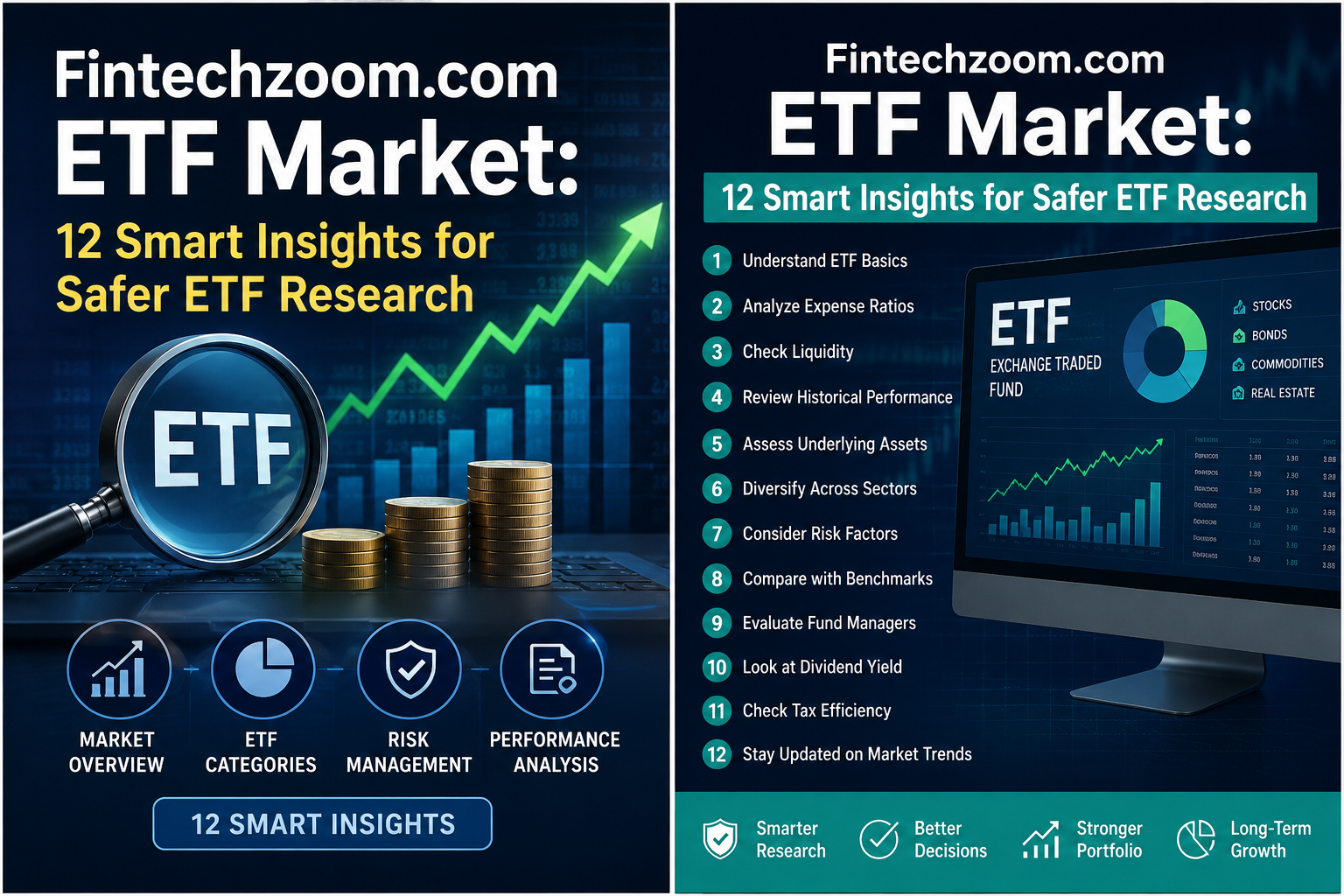
How to Evaluate an ETF Before Trusting the Hype
A useful ETF checklist can prevent rushed decisions. Before acting on market commentary, review the fund’s official documents and basic data.
Ask these questions:
- What does the ETF actually hold?
- Which index or strategy does it follow?
- How much does it cost each year?
- How liquid is it?
- Does it use leverage, derivatives, or futures?
- How has it behaved in down markets?
- Is it suitable for long-term holding or short-term trading?
- Does it overlap with funds already in the portfolio?
The SEC’s investor bulletin explains ETFs as investment products and encourages investors to understand how they work before buying. That reminder fits perfectly with any Fintechzoom.com etf market res20866search7
Future Trends Shaping ETF Research
ETF research is changing quickly. Investors now watch not only broad index funds but also active ETFs, crypto ETFs, ESG funds, income strategies, and single-stock products.
Three trends stand out.
First, active ETFs are growing as asset managers bring stock-picking and risk-managed strategies into the ETF wrapper. Second, crypto-related ETFs are making digital asset exposure easier through traditional brokerage accounts. Third, AI-powered research tools are changing how investors screen funds, compare holdings, and track market news.
The Fintechzoom.com etf market topic will likely keep expanding as readers search for simpler ways to understand complex investment products. The best content will explain opportunity and risk in the same breath.
Common Mistakes to Avoid
ETF investing can look simple from the outside. That is both a strength and a trap.
Avoid these mistakes:
- Buying an ETF only because it has performed well recently
- Ignoring the expense ratio
- Overlooking the bid-ask spread
- Confusing a leveraged ETF with a long-term fund
- Assuming all ETFs are diversified
- Forgetting tax and currency effects
- Relying on one website for all research
The safest habit is steady comparison. Use FintechZoom-style summaries for context, then verify the facts with official fund pages, SEC resources, FINRA guidance, and the ETF prospectus.
FAQs About Fintechzoom.com etf market
What does Fintechzoom.com etf market mean?
Fintechzoom.com etf market refers to ETF-related information, market updates, fund explainers, and investment research connected with FintechZoom-style financial coverage. It is mainly useful for learning how ETFs work and how they fit into market trends.
Is FintechZoom an ETF provider?
FintechZoom is best understood as a financial news and information website, not an ETF issuer. ETF issuers are firms that create and manage funds, such as large asset managers.
Are ETFs safer than individual stocks?
ETFs can reduce single-company risk because many hold baskets of securities. However, they still carry market risk, sector risk, liquidity risk, and sometimes specialized risks depending on the fund type.
What should I check before buying an ETF?
Check the ETF’s holdings, expense ratio, benchmark, trading volume, bid-ask spread, issuer, risk level, and long-term fit. Also review the fund prospectus before making a decision.
Can beginners use ETF market research?
Yes. Beginners can use ETF research to learn basic ideas like diversification, fees, index tracking, and risk. The key is to start with broad education before moving into complex ETFs.
Why do ETF fees matter so much?
Fees reduce returns over time. Even a small difference in expense ratios can matter when money stays invested for many years.
Are crypto ETFs part of the ETF market?
Yes, crypto-linked ETFs are part of the broader exchange-traded product landscape. They can offer easier access to crypto exposure, but they may carry high volatility and regulatory risk.
How often should ETF research be updated?
ETF research should be updated whenever major market conditions change. Interest rates, sector leadership, fund flows, new regulations, and issuer changes can all affect ETF analysis.
Final Takeaway
The Fintechzoom.com etf market topic is valuable because it connects ETF education with real market awareness. It helps readers understand how exchange-traded funds work, why they are popular, and what risks deserve attention.
A strong ETF research process is simple but disciplined. Read the market summary, study the fund details, compare costs, check liquidity, review risks, and verify claims with trusted sources.
Used wisely, Fintechzoom.com etf market research can become a helpful starting point for clearer ETF decisions. Used alone, it is incomplete. The smarter path is to combine accessible financial coverage with official data, balanced risk checks, and patient analysis.